|
Plans for the 81foot high Walker Memorial Pillar
 were completed in 1826. After the completion of the pillar it played a central role in the celebrations. In 1832 we saw the first occasion of the burning of the effigy of Colonel Lundy, the English Protestant Governor during the early part of the Siege. A bomb destroyed the pillar in the early 1970s. The Memorial plinth was restored for the three hundredth anniversary of the siege. The Apprentice Boys placed the statue, which was on top of it in a newly constructed Memorial garden beside the Memorial Hall at 13, Society Street. The Walker memorial, erected in the memory of siege hero Reverend George Walker, used to stand next to the Hall on the walls overlooking the Bogside. But it was blown up in the 1970s, presumably by the IRA or another Republican group. It was here that the Apprentice Boys, beginning in 1832, would every year burn effigies of Lundy, the governor of the city at the start of the siege who plotted to hand it over to the Catholic King James. According to Orange lore, the 13 brave Apprentice Boys preempted Lundy by shutting the gates of the city in the face of James's army and his name has become a byword among Protestants for treachery. were completed in 1826. After the completion of the pillar it played a central role in the celebrations. In 1832 we saw the first occasion of the burning of the effigy of Colonel Lundy, the English Protestant Governor during the early part of the Siege. A bomb destroyed the pillar in the early 1970s. The Memorial plinth was restored for the three hundredth anniversary of the siege. The Apprentice Boys placed the statue, which was on top of it in a newly constructed Memorial garden beside the Memorial Hall at 13, Society Street. The Walker memorial, erected in the memory of siege hero Reverend George Walker, used to stand next to the Hall on the walls overlooking the Bogside. But it was blown up in the 1970s, presumably by the IRA or another Republican group. It was here that the Apprentice Boys, beginning in 1832, would every year burn effigies of Lundy, the governor of the city at the start of the siege who plotted to hand it over to the Catholic King James. According to Orange lore, the 13 brave Apprentice Boys preempted Lundy by shutting the gates of the city in the face of James's army and his name has become a byword among Protestants for treachery.
'Over the last twenty-five years the Apprentice Boys have witnessed a phenomenal increase in membership and general interest in the history of the siege and the Association. It is obvious that Protestants are rallying to the Crimson colours in troubled times as their forebears did throughout the centuries.' Apprentice Boys statement, 1996.
Governor Walker's fine pillar, in recent times suffered a sad end when 'mysterious' bombers sealed its fate. The truth has yet to be told about this incident but the headquarters of the Apprentice Boys Association at the Memorial Hall still survives despite repeated organised attacks over the years. The foundation stone of the Hall was laid on 12th August 1873. Underneath the foundation stone, in hermetically sealed tin cases
were placed coins of that year, most recent issues of all local papers, a copy of Hemptons "Siege and History of Londonderry" and a parchment with names of the committee etc. The baronial 'Scottish style' building was opened on the 13th August 1877 at an estimated cost of £3,250 while the large extension was opened in 1937 at a cost of £30,000. All the celebrations connected with the Siege centre around the Hall and all newly elected candidates for the brotherhood of the Apprentice Boys must be initiated within the historic Walls of Londonderry.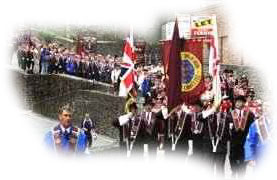
Most credit for the formation of the Apprentice Boys Association and the celebrations must go to the Siege Governor and the hero Colonel John Mitchelburne. To him must be ascribed the distinction and honour of preserving trophies of triumph captured during the Siege and placing them in the Cathedral. The giving of the City and the Apprentice Boys their own distinctive Crimson colour and flag. The formation of the first Apprentice Boys club of which he was principle organiser and probably first President, forerunner of later Governors. The planning of the earliest anniversary celebrations. The first hoisting of the Crimson Flag on the Cathedral tower.
Top-Banana
Productions©2001 |

